
Teacher Zone : Blog : EYFS Lesson Plan: Spring Garden Tuff Tray
EYFS Lesson Plan: Spring Garden Tuff Tray
⭐ Learning Intentions
By the end of this activity, children will:
Fine Motor Skills
- Develop small motor movements needed for early mark-making and writing.
- Strengthen finger, hand and wrist muscles through pinching, squeezing, twisting, grasping and pegging actions.
- Use a range of fine motor tools (tweezers, tongs, pegs, pipettes) with increasing control and confidence.
Characteristics of Effective Learning
- Explore materials through open-ended sensory play.
- Demonstrate active learning through sustained concentration and persistence.
- Think critically while choosing tools, solving small challenges, and making decisions in the spring garden environment.
Understanding the World
- Talk about signs of spring and changes in the natural world.
- Use descriptive vocabulary related to spring, growth and nature.
🎯 Success Indicators (What You’re Looking For in Observation)
Children:
- Use tools such as tweezers, tongs and pegs with increased control and precision.
- Manipulate small items (seeds, beads, pom-poms) confidently and safely.
- Show focus and perseverance during fine motor tasks.
- Use vocabulary such as pinch, squeeze, twist, push, pull during play.
- Engage imaginatively with the spring garden setup and explain what they are doing.
📘 EYFS Curriculum Links
Physical Development – Fine Motor Skills
- Develop their small motor skills so they can use a range of tools competently, safely and confidently.
- Use their core muscle strength to achieve good posture for sitting at a table or on the floor.
- Develop the foundations of a handwriting style that is fast, accurate and efficient.
Communication & Language
- Engage in back-and-forth conversations during play.
- Use new vocabulary in context (e.g., roots, petals, seeds, grow, sprout).
Understanding the World
-
Explore natural themes and talk about growth, insects and seasonal changes.
Characteristics of Effective Learning
- Playing & Exploring: Engaging with sensory elements and spring-themed resources.
- Active Learning: Maintaining interest, trying again, showing pride in accomplishments.
- Creating & Thinking Critically: Making choices, solving problems (e.g., “How can I pick up the smaller seeds?”).
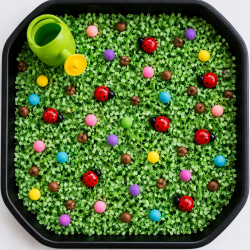
🧺 Resources – Spring Garden Tuff Tray
Base
-
Green fabric, shredded paper, or felt.
Fine Motor Tools:
- Tweezers / child-safe tongs
- Pegs
- Pipe cleaners
- Small pots or egg boxes
- Dried pasta or beads (“seeds”)
- Mini pom-poms (“flowers”)
- Playdough (optional for “soil”)
Spring Additions:
- Plastic insects
- Silk flowers or flower cut-outs
- Small watering cans (empty)
Tray Setup:
- Pots arranged as “flower beds”
- Pom-poms/beads scattered as seeds
- Insects hidden throughout the tray
- Pegs clipped to edges as “garden fences”
- Pipe cleaners pushed into playdough to create “flowers”
Lesson Structure
1. Introduction (5 minutes - Whole Group)
- Gather children around the tray.
- Introduce the theme: “We’re exploring a spring garden today.”
- Discuss: “What changes do we notice in spring?”
- Share learning intentions clearly:
- “We’re going to practise our finger muscles today.”
- “We’ll be using tools like gardeners.”
2. Fine Motor Play Activities (20–25 minutes)
Children rotate freely around the tray, engaging in:
🌼 Core Activities
- Picking up seeds (beads/pasta) with tweezers and placing them into pots.
- Pegging pipe-cleaner flowers onto the edge of the tray.
- Pushing pipe cleaners into playdough to create flowers.
- Sorting pom-poms by colour using tongs.
- Finding insects hidden in the “grass” and transporting them with tools.
🎙️ Adult Language Support
Use action words:
pinch – squeeze – twist – push – pull – pick – place – press – drop
This reinforces both technique and vocabulary.
3. Teacher’s Role
- Model correct tool grip naturally and subtly.
- Narrate actions (“You’re pinching tightly with your fingers”).
- Scaffold when needed: “Try turning your wrist this way.”
- Celebrate effort, not perfection.
- Observe hand preference, tool use, muscle strength and bilateral coordination.
🌟 Extension Opportunities
For children ready for extra challenge:
- Write plant labels (emergent writing links).
- Counting seeds into pots (numeracy link).
- Create repeating patterns with flowers.
- Timed challenges (“How many flowers can you peg in 30 seconds?”).
- Use smaller items for increased precision.
🌈 Differentiation
Support:
- Offer larger objects.
- Reduce number of materials to avoid overload.
- Allow finger use instead of tools to build foundational skills.
- Provide hand-over-hand guidance only when necessary.
Challenge:
- Smaller beads or tweezers
- Multi-step tasks (pick, sort, plant)
- Non-dominant hand challenges
- Pattern-copying cards
Assessment & Observation
Focus on:
- Grip strength and tool control
- Wrist stability
- Ability to sustain focus
- Confidence and risk-taking
- Use of vocabulary
- Evidence of problem-solving
Record using:
- Photographs
- Sticky notes for learning journals
- Short annotation linked to PD statements
Continuous Provision Link
Keep the tray available all week. Refresh daily by:
- Adding new insects
- Switching to pipettes, scissors, scoops
- Introducing new spring vocabulary cards
- Adding real bulbs or herbs for planting
This repetition strengthens skills, builds independence, and supports mastery of fine motor movements.